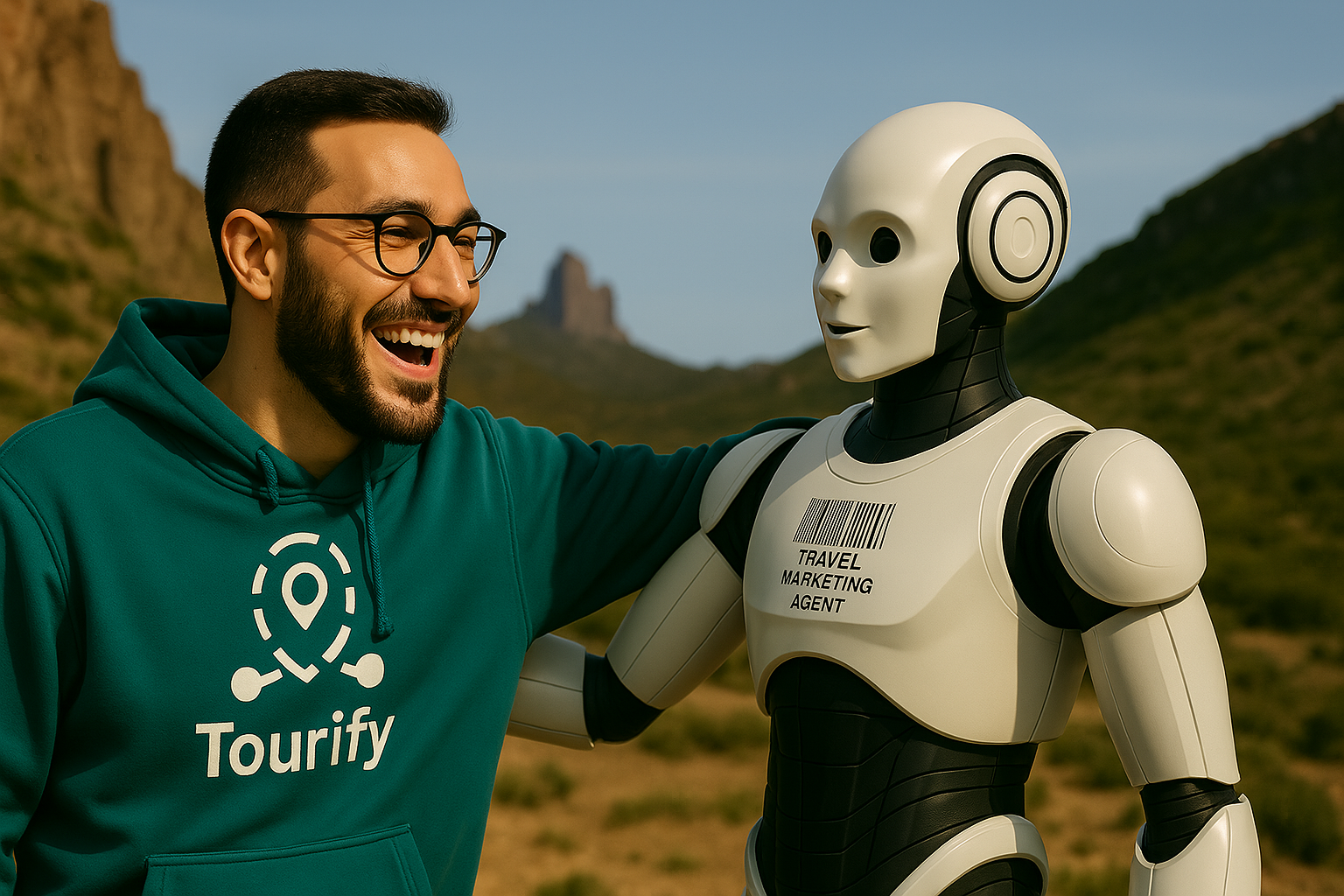
If you run tours or experiences, AI isn't a distant trend you can monitor from a safe distance. It's already changing how travellers find you, how they decide to book, and how your competitors are spending their marketing budgets.
The operators who understand this shift now will take bookings from those who don't. This post breaks down exactly what's changing, what it means in practice, and the steps worth taking before your pipeline feels it.
How is AI changing travel marketing?
The change isn't cosmetic. It's structural.
How travellers are actually searching now
The shift is already measurable. According to ABTA’s Holiday Habits 2025–26 report, the number of UK adults using AI for holiday inspiration doubled in a year — from 4% to 8% — with nearly one in five 25–34-year-olds now using AI tools to plan trips.
A few years ago, a potential guest searched "Costa Rica eco tours" and landed on a results page. They clicked a few links, compared some sites, and eventually booked. That journey is changing fast.
More people now use AI assistants like ChatGPT, Gemini and Copilot to research and compare tours — typing longer, more specific queries than ever before. Instead of "Costa Rica eco tours", they're asking: "What's the best eco tour in Costa Rica for a couple in their 40s who want wildlife, not crowds?"
Travellers ask ChatGPT for trip ideas, get instant AI summaries on Google, and rely on conversational planning tools built directly into Booking.com and Expedia — so more of the awareness and research journey now happens inside AI tools, where clicks are no longer the primary outcome.
Will AI replace travel marketing agencies?
The agencies that use AI as infrastructure while applying genuine strategic thinking will significantly outperform those that don't — in both results and efficiency. The question isn't whether to use AI. It's whether your agency is using it on your account.
What AI actually enables in travel marketing right now
AI in travel marketing: the old way vs now
| Marketing task | The old way | What AI enables now |
|---|---|---|
| Traveller discovery | Search “Costa Rica eco tours” and scan a results page | Conversational AI queries — you have to be cited by the AI tool itself |
| Paid bidding | Manual bids and daily tweaks | Real-time optimisation that shifts budget automatically (only as good as your data) |
| Audience & creative | One message for everyone | Creative, landing and email personalised by behaviour — live in Advantage+ and PMax |
| Booking insight | Report on what already happened | Predict which sources and audiences convert before the booking |
Smarter paid advertising
AI-powered bidding in Google Ads and Meta doesn't just automate spend — it optimises toward outcomes in real time. For tour operators running seasonal campaigns, that means budgets that shift automatically toward higher-converting audiences, times and placements without daily manual intervention.
The catch: garbage in, garbage out. AI bidding is only as good as the conversion data feeding it. Operators with poor tracking — missing server-side events, uncaptured phone bookings, broken thank-you page goals — are handing the algorithm bad signals and wondering why performance is erratic.
Personalisation at the audience level
AI can now segment and personalise ad creative, landing page messaging and email sequences based on browsing behaviour, past interactions and declared preferences. A traveller who spent three minutes on your family tours page sees different messaging than one who lingered on your private group experiences. This isn't theoretical — it's running inside Meta's Advantage+ and Google's Performance Max right now.
Predictive analytics for booking patterns
AI tools can help you tailor offerings based on customer preferences, past bookings and even social behaviour — matching the right tours with the right travellers. For operators with historical booking data, AI can identify which traffic sources, audiences and campaigns are most likely to convert before the booking happens, not just after.
What should tour operators actually do?
Most AI content aimed at tour operators is vague. "Embrace AI." "Leverage automation." Here's what's actually worth actioning:
1. Fix your tracking before anything else. AI-powered campaigns — Google PMax, Meta Advantage+ — need clean conversion signals to optimise toward. If your booking confirmations aren't firing events server-side, your campaigns run on incomplete data. This is the single highest-leverage infrastructure fix available to most operators, and we cover it fully in our guide to server-side conversion tracking.
2. Restructure your content for AI search. Structuring your website around guest-focused answers and AI-friendly formatting captures more organic traffic and positions you for AI-assisted search. Practically: clear H2 questions, direct extractive answers under each, and an FAQ section on every key page — the core of AI search optimisation.
3. Treat your Google and Meta campaigns as data engines, not just ad platforms. The best returns come from operators feeding clean first-party data back into the platforms, building audience segments from their own CRM and booking system, and letting AI optimisation handle bidding while humans focus on offer, positioning and creative.
4. Don't wait for your booking window to notice the gap. The number of people using AI for holiday inspiration is doubling year on year. The operators building AI-ready infrastructure now will have a compounding advantage by the time it becomes the obvious move.
The bottom line
AI in travel marketing isn't a feature update. It's a shift in how bookings get made — from how travellers find tours, to how platforms decide which ads to show, to how campaigns are optimised in real time.
The operators who'll feel this most aren't the ones ignoring AI. They're the ones who've heard the noise, done nothing structural, and assumed their current setup will hold.
Frequently asked questions
How is AI changing how travellers find tour operators?
Travellers are increasingly using AI tools like ChatGPT and Google's AI Overviews to plan trips, bypassing traditional search results. This means tour operators need content structured for AI extraction — clear answers to specific questions — not just keyword-optimised pages.
Do tour operators need AI in their marketing strategy?
Yes, but not in the way most people mean. AI is already embedded in the platforms you're likely using — Google Ads, Meta, email tools. The question is whether those tools are being configured and fed the right data to make AI-driven decisions that actually improve bookings.
What's the most important AI-related change for tour operator marketing right now?
Server-side conversion tracking. AI-powered ad platforms optimise toward the signals you give them. If those signals are incomplete — missing phone calls, uncaptured form fills, broken booking confirmation events — the AI optimises toward the wrong outcomes. Fix the data layer first.
Will AI replace digital marketing agencies for travel companies?
No. AI handles execution and optimisation at scale. It doesn't handle positioning, strategy, creative direction, or the nuanced decisions that come from understanding a specific market. Agencies that use AI as infrastructure while applying real strategic thinking will outperform those that don't.
See what AI-ready marketing looks like for your tours
Tourify is a performance marketing agency built exclusively for tour operators and DMCs. Tell us your setup and we’ll show you exactly what AI-ready marketing infrastructure looks like for your business — no pitch, no obligation.
Get in touch →