Tourify is an SEO company for tour operators, tour companies and DMCs. Travel is the only industry we work in. Most agencies selling travel SEO have never sold a tour in their lives — we build organic visibility around how travellers actually research and book, from the first destination search to the enquiry twelve weeks later.
We’re a specialist travel marketing agency built around how travellers actually research and book. SEO is where most of those journeys begin.
Talk to us about your SEOWhy search visibility is harder for travel companies right now
The travel search landscape shifted in 2025. AI Overviews now sit above the organic results for a large share of travel queries, and they answer the planning-stage questions that used to bring people to your destination pages. Zero-click searches are rising. The brands still winning organic traffic are the ones with genuine topical depth — and the ones AI assistants have a reason to cite.
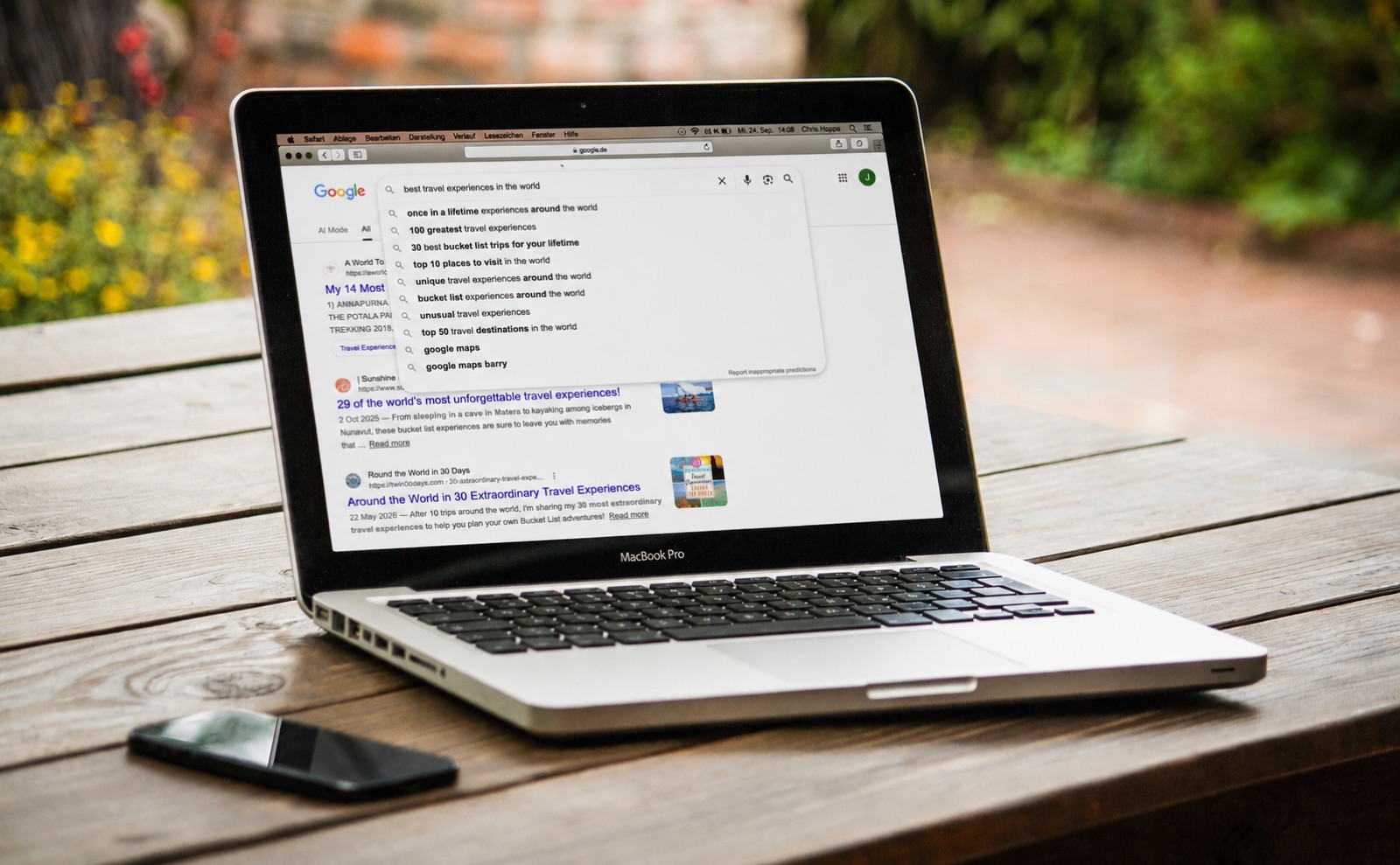
Winning organic visibility now means comprehensive destination content, structured itinerary pages, and a site architecture that search engines can actually trust. Most travel companies don’t have that. They have thin tour pages, a neglected blog, and a homepage that ranks for their own name and nothing else.
That’s the gap Tourify closes.
Travel SEO services built around how tour operators actually sell
SEO for travel companies requires a different playbook to generic B2B or e-commerce SEO. Your buyers research for weeks before they enquire — comparing destinations, reading itineraries and assessing whether they trust you with a significant spend, often £3,000 to £15,000+ (roughly $4,000–$20,000 / €3,500–€17,500) per booking. Every element of your organic presence has to do work at each stage of that research journey.
What does an SEO and GEO strategy for travel companies include?
A travel SEO and GEO strategy covers four things: technical fixes so search engines can crawl and render your tour pages, destination and itinerary content built around planning-stage search, schema that describes your tours in a format machines can read, and GEO — generative engine optimisation — so AI assistants cite you when travellers ask them where to book.
Our travel SEO services cover:
Technical SEO audit & site architecture
Travel sites accumulate technical debt fast — oversized hero images, duplicate destination pages, broken canonicals, slow mobile load. We audit the full site against current search requirements and prioritise fixes by ranking impact, not complexity.
Destination & tour page optimisation
Your destination guides, tour listings and itinerary pages are where bookings originate. We rebuild their on-page architecture — title tags, heading hierarchy, keyword integration, internal linking and schema — so every page earns its place in results.
Content strategy & topical authority
Ranking in competitive travel verticals takes a structured content network: pillar pages for your core destinations and tour types, supported by clusters that answer the questions your ideal traveller asks at every planning stage. We build and execute that network.
Schema markup for travel businesses
Schema helps search engines and AI assistants understand your tours, prices, dates and business details. We add the schema.org types that fit each page, such as TouristTrip, Event and Organization, and keep them matched to what the page shows. Schema doesn’t guarantee rich results (Google stopped showing FAQ rich results in May 2026), so we treat it as housekeeping, not a shortcut.
Link building & digital authority
Travel authority is built through editorial coverage — travel press, destination guides, industry bodies, niche travel blogs. We identify and secure relevant links that build domain authority without shortcuts that risk your rankings.
AI Search & AEO
AI engines — Google’s AI Mode, Perplexity, ChatGPT — are increasingly the first stop for travel research. We structure your content so it’s cited, not bypassed: answer-first formats, self-contained FAQs and entity-level completeness. See our AI search optimisation service.
SEO for tour booking engines: FareHarbor, Bókun, Rezdy and Peek Pro
SEO for tour operators has to include the booking engine, and that’s usually where general agencies stop looking. A tour can rank and still lose the booking if the widget hides its content from search engines, sends the traveller to another domain, or breaks the tracking that shows organic search produced the sale.
A booking widget isn’t bad for SEO in itself. What matters is how yours is set up. In every technical audit we check five things.
- Every bookable tour has its own indexable page. If a tour only exists inside a widget or on the booking platform’s own URL, there’s nothing on your site for Google to rank. Each tour needs a page on your domain with the itinerary, duration, inclusions and price in the HTML.
- Search engines can read the page without the widget. Many booking widgets load through JavaScript or an iframe. We compare the raw HTML with the rendered page, so descriptions and prices aren’t only visible once the script runs. Several AI crawlers are reported not to run JavaScript at all.
- Your tour pages aren’t competing with copies of themselves. The same tour can appear on your site, on the booking platform’s hosted page and on OTA listings with near-identical text. We check which version Google shows for your tour names and make your own page the one worth ranking.
- Date pickers and booking parameters aren’t creating duplicate URLs. Calendars, currency switchers and tracking parameters can generate hundreds of near-identical addresses. We check how search engines are treating them.
- The journey from search result to confirmed booking is measured. When checkout happens on the booking platform’s domain, analytics often credits the sale to the platform or to “direct” instead of the Google search that started it. We fix the cross-domain tracking so organic bookings are counted. See booking tracking for tour operators.
We also check whether your tours can appear in Google’s Things to do listings, which can show a booking link for your tour in search. Google recommends that smaller operators connect through a supported booking platform rather than integrating directly, so what’s possible depends on the system you use. Our guide to why booking systems break conversion tracking covers FareHarbor, Bókun and Peek Pro in more detail.
Which page should rank for which search?
Each tour search needs a different type of page. Many tour operator sites answer “[destination] tours” with a blog post, when Google tends to reward a page listing bookable tours with prices. Matching page type to search intent is one of the first things we fix.
Here’s how we’d map searches for a Costa Rica tour programme, a destination we work in.
| Search | Page that should rank | What the page has to do |
|---|---|---|
| Costa Rica tours | Tour listing page | Show bookable tours with prices and durations near the top, not an article |
| Arenal volcano and hot springs tour | Individual tour page | Itinerary, inclusions, price, availability and a clear route to book |
| Costa Rica family itinerary 10 days | Itinerary page | A day-by-day plan the traveller can book as it is or tailor |
| Best time to visit Costa Rica | Planning guide | Answer the question first (dry season December to April, green season May to November), then link to the tours that fit |
| Costa Rica tour prices | Pricing guide | Real price ranges, what moves a trip up or down the range, and links to the tour pages |
| Private Costa Rica tour | Private tours page | Who it suits, how pricing works and how to enquire |
The table shows the pattern, not a keyword list. Before building anything we check which searches have real demand in the markets you sell to, what already ranks for them, and where your site already has impressions to build on.
Who is Tourify’s travel SEO service for?
Tour operators
Whether you run a single-country specialist operation or a multi-destination touring programme, your site needs to rank for the itineraries and experiences you actually sell — not just your brand name. We build the content architecture that captures planning-stage search and converts it into enquiries.
Destination management companies
DMCs face a B2B search challenge — your buyers are travel trade, not consumers, searching “Morocco DMC” or “Kenya ground operator”. We build your strategy around trade-press authority, case-study depth and the supplier-tier signals that matter for B2B credibility. See our dedicated DMC marketing service.
Experience-led travel brands
Boutique safari operators, wildlife tour specialists, adventure travel companies. If your offering is experience-first and differentiated, your SEO should reflect that — not borrow from OTA playbooks. We build topical authority around your niche so you become the reference point in your category.
Why work with a travel-only SEO agency?
Most SEO agencies serve everyone — dentists, solicitors, e-commerce stores, and occasionally a tour operator. Their travel knowledge is Wikipedia-level. They can’t tell the difference between a touring circuit and an FIT itinerary, and they write destination content that sounds like no one who has ever been there.
That matters because E-E-A-T — Google’s framework for evaluating content — now explicitly prioritises Experience, Expertise, Authoritativeness and Trustworthiness. Travel is one of the highest-scrutiny verticals under this framework. Generic, surface-level content underperforms; content built from genuine vertical expertise outranks it.
Tourify works exclusively in the travel vertical. Every client we take on is a tour operator, DMC, or experience-based travel brand. We don’t split our attention across sectors. Everything we’ve learned about search in the travel industry — how seasonality distorts data, why OTA pages outrank operator pages, what an AI assistant needs to see before it recommends a tour — comes from working only here. That means:
- No learning curve. We already understand your sales cycle, your buyer’s decision process and your competitive landscape.
- Faster execution. Content briefs don’t need to explain what a self-guided itinerary is or why Green Season matters.
- Better content. Content is written by the people running your campaigns — not handed to a freelancer who’s never sold a tour. That’s the whole point of a small agency that only works in travel.
How we measure organic bookings, not just rankings
We measure SEO for tour operators by the bookings and revenue it produces, not by rank position alone. That means joining up Google Search Console, GA4 and your booking platform, so you can see which pages and searches lead to confirmed bookings.
Monthly reporting covers four layers.
- Search visibility. Impressions, clicks and click-through rate from Search Console, by page and by query. We strip out the automated queries generated by AI-tracking tools and scrapers, which can make up a large share of a travel site’s impressions and distort its average position.
- Qualified traffic. Organic visits to tour, destination and itinerary pages from the markets you sell to. Impressions from countries you don’t sell to aren’t progress.
- Enquiries and bookings. Organic enquiries and completed bookings, tracked to your booking platform’s confirmation rather than stopping at the click on “Book now”.
- Revenue. Booking value by organic landing page, so you can see which content earns its place and where to invest next. Travellers often visit several times before they book, so we show organic search’s role in assisted bookings as well as last-click, and state which attribution method each figure uses.
We report rankings from Search Console rather than third-party rank trackers, which have been less reliable since Google stepped up blocking of automated rank checks in September 2026. If your booking platform can’t pass booking revenue back yet, we tell you what’s missing and how to fix it instead of estimating.
How we run travel SEO campaigns
Technical audit including your booking engine and tracking, keyword research scoped to your destinations and tour types, competitor gap analysis and a content architecture map. You understand exactly what’s holding your rankings back — and what the roadmap looks like — before any ongoing work begins.
Commercial pages — tour listings, destination guides, key landing pages — restructured and optimised. Schema implemented, internal linking connected, and title tags and meta descriptions rewritten for both ranking and click-through.
Content network expansion, link acquisition and AEO/AI search optimisation, with monthly reporting on search visibility, organic bookings and booking revenue.
No lock-in contracts. We earn your business monthly.
What this looks like in practice
An Alaskan guided-tour operator came to us on page four or five of Google after two years with a previous agency, carrying a manual penalty from low-quality backlinks that agency had built. We disavowed the links, rebuilt the content and, within 12 weeks, rankings were back at the top of Google, with a sister site also on page one. Read the full case study.
Common questions about travel company SEO
How long does SEO take for a travel company?
Most travel companies begin to see measurable movement in rankings within 3–4 months of on-page work being completed, with significant organic traffic growth typically visible at 6–9 months. The timeline depends on your current domain authority, the competitiveness of your destination and tour-type keywords, and how much content work is required. Tourify provides realistic projections based on your specific starting position — not industry-average estimates.
What makes travel SEO different from general SEO?
Travel SEO involves much longer buyer research cycles, high keyword competition from large OTAs and booking platforms, content requirements tied to destinations and itineraries rather than static services, and a strong seasonal traffic dimension. Effective travel SEO also increasingly requires AEO (Answer Engine Optimisation) — structuring content to be cited by AI search tools like Google AI Mode and Perplexity, which are now heavily used for destination research.
Do booking widgets hurt SEO for tour operators?
Not by themselves. Problems come from how the widget is set up: tour content that only exists inside JavaScript or an iframe, checkout on another domain that breaks tracking, or the same tour description copied across your site, the booking platform and OTA listings. A technical audit shows which of these applies to your site.
Do you work with DMCs or only B2C tour operators?
Both. DMCs face a B2B search challenge — sourcing searches from travel trade, not consumers — and we adapt strategy accordingly. B2B travel SEO prioritises different content types (case studies, destination expertise pages, trade-facing landing pages) and different authority signals than a consumer-facing tour operator.
Can you help with both SEO and paid media for travel?
Yes. Tourify’s parent agency, Bons & Frazer, handles Google Ads and Meta Ads alongside SEO. For travel companies, integrating paid and organic strategy — especially using GSC data to identify high-intent queries worth bidding on — is a significant competitive advantage. We coordinate across both channels rather than running them in siloed campaigns.
Do you offer travel SEO without long-term contracts?
Yes. We operate on a rolling monthly arrangement. Our retention model is built on results, not contractual lock-in.
Ready to turn organic search into your best booking channel?
If your travel company is invisible on Google or over-reliant on paid traffic and OTA listings, there’s a better way. Tell us about your tour operation — the destinations you specialise in, what’s working and what isn’t — and we’ll tell you exactly where the organic opportunity is.
Book a Free SEO Discovery CallSee how we approach travel SEO →