
Pull last season's booking export and do one sum. Say 1,300 of your 2,000 bookings came through OTAs, at an average of £110 and 25% commission (illustrative numbers; real rates by platform are on our OTA commission rates page). That season you paid £35,750 in commission, or 16.25% of everything you sold. To reduce OTA commission, split that £35,750 into what bought customers you could not have reached and what you paid on people already looking for you.
When we audit an operator's booking tracking, we ask for access to Google Search Console and Google Analytics, plus that channel export from the booking system. The export matters because OTA bookings never touch your website, so GA4 never sees them. The second slice, the people who already knew your name, is where commission comes down fastest.
Which OTA bookings can you realistically move direct?
The OTA bookings you can move direct are the ones where the customer already knew your brand: people who searched your name and clicked an OTA result, past guests rebooking through the marketplace, and people who found you on Google Maps then booked through the OTA link beside your listing. Discovery bookings are much harder to move.
Your OTA booking records normally include the lead traveller's name, so match it against your own customer list to count repeat guests who came back through a marketplace. Then check monthly brand searches in Google Search Console. If brand searches are high and your direct share is low, travellers are finding your name and finishing the purchase somewhere that charges you for it.
Check your OTA agreement before you touch your prices
Most OTA supplier agreements include rules about the rates you give them, and some cover the prices you show elsewhere. Those rules differ by platform and change over time, so start with the agreement you actually accepted, which sits in your supplier account. We are a marketing agency, not lawyers, and nothing in this guide is legal advice. If a clause is unclear, ask your OTA account manager in writing or speak to a solicitor.
The terms are moving, too. Viator issued an updated supplier agreement in August 2026, and Skift reported that it lets channel partners such as airlines, packagers and banks set the retail price of your experiences, while you keep supplying net rates and recommended retail prices. Your tour can end up cheaper on a partner site than on your own without you doing anything. That is one more reason to compete on what direct bookers get rather than on price, which is what the rest of this guide covers.
How do you reward direct bookers without changing your price?
Give direct bookers something the OTA listing does not include, and keep the headline price the same. That way the headline price matches everywhere, and the reason to book direct is what comes with it.
- Add a booking-only inclusion: a photo pack sent after the tour, a drink at the end, priority seating on the boat, or free date changes up to 48 hours before departure. Cost each one, since an inclusion is a discount paid in kind.
- Sell a product the OTA does not carry. A private version, a longer route or a sunrise departure that only exists on your website cannot be price-compared.
- Run a returning-guest offer by email to people who opted in with you. Check with your OTA account manager that a code sent only to your own list is fine under your agreement.
Is an OTA bidding on your brand name in Google?
Check Auction insights on your brand campaign, or search your brand name in a private browser window. If a marketplace ad sits above your website, every click on it turns a traveller who was looking for you into a commissioned booking.
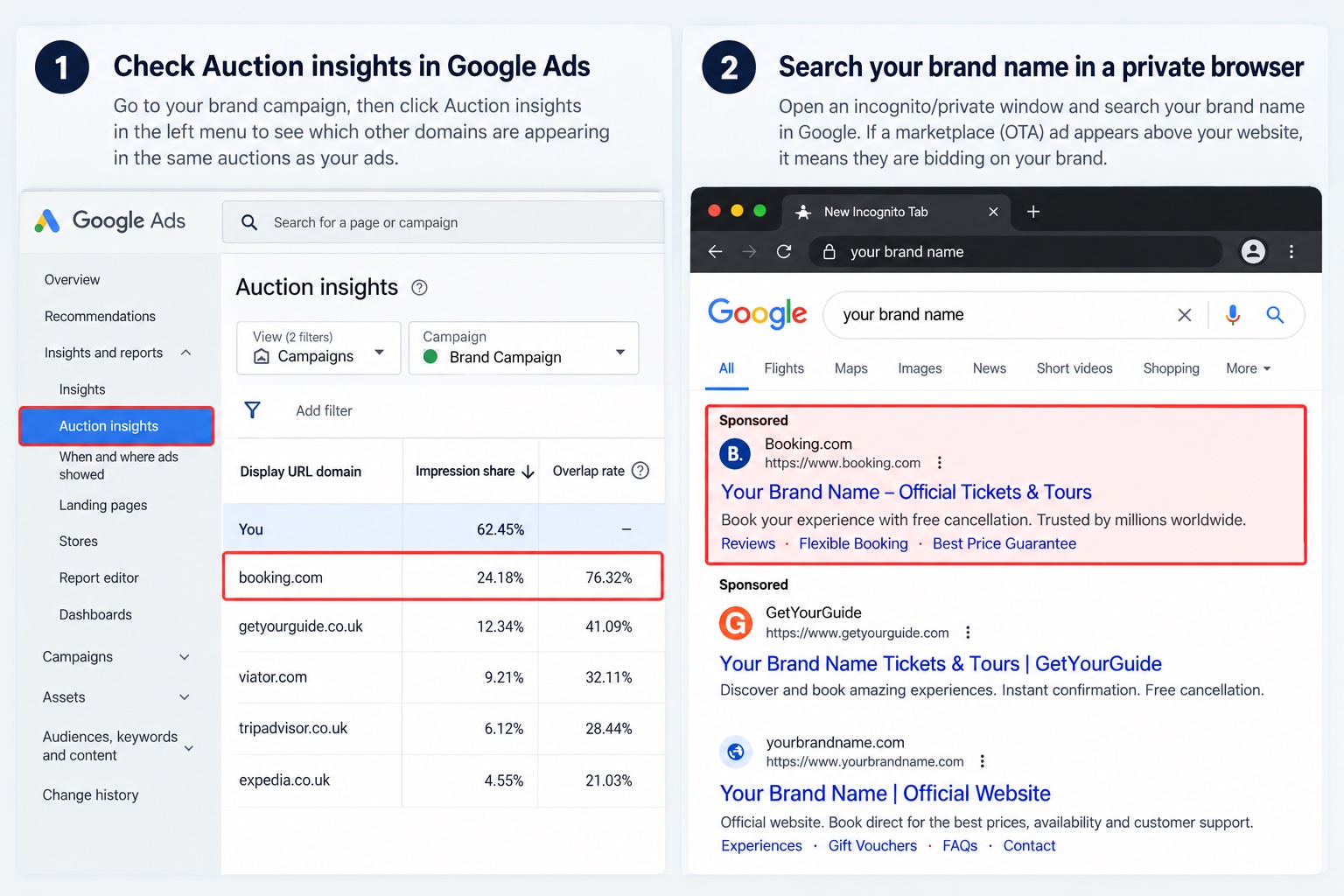
You cannot stop this through Google's trademark complaints process. Google's policy lists "Using trademarks as keywords" among the things it will not restrict, and it allows trademarks in ad text for resellers whose landing page clearly facilitates the sale (source: Google Ads trademark policy). An OTA selling your tour fits that description (Google decides each complaint).
The defence is a brand search campaign of your own. Your site is the most relevant result for your own name, which helps you in the auction, and your ad pushes the OTA listing down. Send the ad to the booking page, and exclude brand terms from your other campaigns so brand defence has its own cost line. Our Google Ads management for tour operators covers how we structure this.
Google Things to Do: free booking links, with conditions
Google Things to Do lets tour operators show bookable tours in Search and Maps with a link to their own booking page, and Google introduced ticket booking links "at zero cost" in 2021 (source: Google, September 2021).
The conditions:
- You need a Google Business Profile. Google lists "All attraction businesses and tour operators" as eligible to add tickets or activities, and each entry requires a name and a booking URL (source: Google Business Profile Help).
- The total price on your booking page "should be the same as the total price displayed on Google", including all fees and taxes (source: Things to do price policies). A booking fee added at checkout breaks this rule.
- Google recommends operators connect through a connectivity partner rather than integrating directly (source: Google Things to do developer overview). Bokun, FareHarbor, Rezdy, Xola, TrekkSoft, Ventrata and Bookingkit are on Google's launched partner list (source: Google's connectivity partner list).
Viator, GetYourGuide, Klook and Tiqets are on the same partner list. If your tours are on those marketplaces, their booking options can appear on the same Google listing as yours (what Google shows varies by product and market).
Those bookings only show in your reports if conversion tracking survives the handoff to your booking platform. On FareHarbor, our FareHarbor conversion tracking guide covers where that breaks.
Can you remarket to guests who booked through an OTA?
Not with the contact details the OTA passed on. Those are given to you so you can deliver the booking, and OTA agreements usually limit using them for marketing, so check yours. Google also only accepts Customer Match data "collected in the first-party context" (source: Customer Match policy).
The OTA guest is standing in front of your guide, though, and the guide can ask for permission directly. Offer the tour photos or a returning-guest price in exchange for an email address, collected on your own form with a clear opt-in. From then on the guest is yours to market to.
OTA guests also visit your website to check the meeting point. With consent mode set up properly, those visits build a remarketing audience for their next trip (size depends on your consent rate).
How do you measure direct versus OTA share properly?
Measure direct share from your booking system, by channel, as both bookings and net revenue, and compare the same months year on year. GA4 and Google Ads cannot, because OTA bookings never happen on your website.
Count net revenue per booking for each channel. For an OTA booking, take off commission. For a direct booking, take off card processing, any booking-platform fee charged on direct sales, and FX costs if you take payment in a currency you do not bank in. Then take off the ad spend that produced the direct booking. A comparison of gross prices overstates the direct advantage.
Two tracking faults distort this comparison in opposite directions. If your booking platform fires a conversion on every booking it confirms, OTA bookings can be counted as Google Ads conversions, which flatters paid search. If your booking widget runs on another domain without cross-domain tracking, direct bookings show up as "(direct)" in GA4 with no source, which hides what brought them. Our booking tracking guide for tour operators covers both, and server-side tracking for booking platforms covers the fix when browser tracking fails.
A change in direct share only counts as Measured when it has a defined baseline period, a comparison period of the same length and season, and a named data source. "Direct went up this summer" becomes a result when you can say, for example, that direct was 35% of bookings in June to August last year and 41% this year, per the booking system export.
A worked example (illustrative numbers)
Every figure below is illustrative. Replace each with your own.
| Line | Before | After |
|---|---|---|
| Bookings | ||
| Total bookings per season | 2,000 | 2,000 |
| Average booking value | £110 | £110 |
| OTA bookings at 25% commission | 1,300 | 1,100−200 |
| Commission | ||
| Commission paid | £35,750 | £30,250−£5,500 |
| Commission as a share of revenue | 16.25% | 13.75%−2.5 pts |
| Cost of winning them direct | ||
| Brand ad spend for 200 moved bookings at £9 each | £0 | £1,800 |
| Card processing on 200 moved bookings at 1.5% | £0 | £330 |
| Net gain | £3,370 |
Each moved booking saves £27.50 in commission and costs £10.65 to win and process, so the operator keeps £16.85 more per booking. The 200 come from the leaked slice: brand searchers caught by a brand campaign and past guests rebooking from a list collected on the tour.
The £3,370 only exists if those 200 bookings would otherwise have gone through an OTA. If some brand searchers would have booked on your website anyway, the campaign bought clicks you already owned. Test it: pause brand ads for two weeks and watch whether OTA bookings rise. To fund the spend from the commission it replaces, see our tour operator marketing budget method.
When should you keep the OTAs?
Keep OTAs for the bookings you cannot win yourself. A new tour with no reviews, a market where nobody searches for your brand, and spare seats on midweek departures in shoulder season are all cases where a commissioned booking beats an empty seat. Under Viator's August 2026 terms, partners can discount your tour while you keep supplying the net rate, according to Skift, which may fill seats you would not have sold.
The break-even sums are on our Viator vs Google Ads comparison.
Frequently asked questions
Can I email customers who booked through an OTA?
Not using the details the OTA passed on. Those are for delivering the booking, not for marketing. Ask OTA guests directly during the tour, on your own sign-up form with a clear opt-in. Once they agree, you can email them and use the list for Customer Match.
Does Google Things to Do charge commission?
Google launched Things to Do booking links at zero cost in 2021. You need a Google Business Profile with a booking URL, a booking page whose total price matches Google's, and usually a connectivity partner such as FareHarbor or Bokun. Things to Do ads are a separate, paid product.
How do I know my direct booking share is actually growing?
Export bookings by channel from your booking system for the same months in two seasons and compare the share of bookings and net revenue that came direct. GA4 and Google Ads cannot see OTA bookings, so they cannot answer this.
Get a free booking-tracking audit
Before you spend a pound moving bookings direct, check that you can see them. Our free audit tests whether your booking platform reports direct bookings to Google correctly and whether OTA bookings are leaking into your Google Ads conversions. Book your free booking-tracking audit.