
Most tour operators, experience providers, and travel businesses don't have a marketing problem. They have a system problem — a handful of disconnected tactics where there should be one strategy built around how travellers actually find, research, and book.
This guide lays out the complete picture: the travel booking funnel, the channels that serve each stage, how to budget across them, why seasonality changes everything, and the tracking foundation that ties it all together. It's written for tour operators, activity providers, DMCs, and experience-led travel brands who want more direct bookings and less dependence on the OTAs.
Tourify works exclusively with travel and tourism businesses. Everything below is the framework we apply across travel marketing strategy engagements.
- What is travel marketing?
- How the travel booking funnel actually works
- What marketing strategies work best for tour operators?
- Which marketing channels should travel businesses use?
- Why seasonality changes everything
- Setting a marketing budget
- Why conversion tracking is the foundation of everything
- Frequently asked questions
What is travel marketing?
The global experiences sector — tours, activities, and attractions — reached $271 billion in 2025 and is projected to hit $342 billion by 2029, growing at 8% annually, faster than any other segment of the travel industry (Arival & Phocuswright, 2026). But how those bookings are distributed is shifting fast.
OTA bookings surged to 37% of all tour and activity bookings in 2025, up from 33% in 2024 and 28% in 2023. Over the same period, direct website bookings fell from 29% to 25% (Arival, Global Operator Landscape 4th Ed., survey of 5,000+ operators). That's not a blip — it's a structural redistribution of revenue toward platforms that take 20–30% of every sale.
Travel marketing exists to reverse that trend. Done well, it builds a direct booking channel that grows in value over time, reduces commission costs, and gives you ownership of the customer relationship the OTAs otherwise control.
The defining challenge is the length and complexity of the journey. A traveller might discover your experience on Instagram, research it on Google three weeks later, compare it against an OTA listing, ask ChatGPT for recommendations, read reviews, then finally book direct after seeing a retargeting ad. Phocuswright describes the modern travel booking journey as "complex, non-linear" — and nearly 40% of US travellers used generative AI tools to plan trips in 2025, an 11-point jump in a single year. No single channel owns the journey. That's exactly why single-channel marketing underperforms for travel brands.
How the travel booking funnel actually works
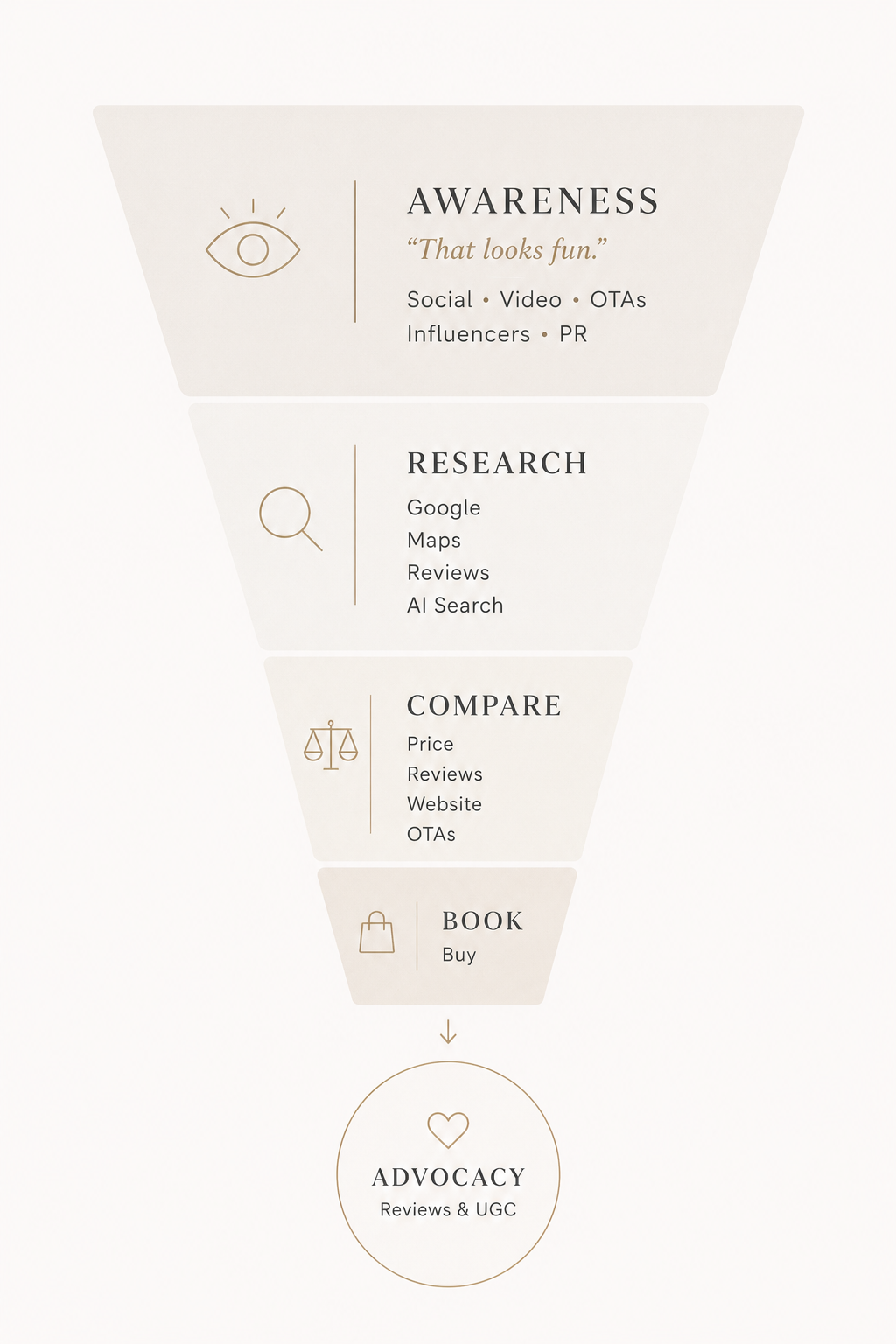
Awareness — "That looks fun."
This is where demand is created. Travellers aren't searching for you yet — they're being inspired. Social media, short-form video, OTA browse pages, influencer content, and PR coverage do the heavy lifting here. 91% of destination marketing organisations use social media for marketing, and 99% rank Facebook and Instagram among their top five channels (Sojern, State of Destination Marketing 2025).
OTAs play a dual role at this stage — they're not just booking platforms, they're discovery engines. A traveller browsing Viator or GetYourGuide for "things to do in Dubrovnik" may see your experience for the first time. The awareness is valuable; the 20–30% commission that follows is the cost. Influencer partnerships and PR coverage serve the same function — planting the idea — but without the ongoing commission.
The mistake travel businesses make is judging this stage on last-click bookings. Its job is to fill the top of the funnel, not close the sale.
Research
Now the traveller is actively looking. They search Google, check Google Maps for location and proximity, read reviews on TripAdvisor and Google Business Profile, and increasingly ask AI search tools like Perplexity, ChatGPT, and Google AI Overviews. This is where SEO and AEO (Answer Engine Optimisation) earn their keep — being the answer when someone researches your kind of experience, regardless of which tool they use to ask.
The rise of AI-assisted trip planning is accelerating this stage. With nearly 40% of US travellers now using generative AI to plan trips (Phocuswright, 2025), your content needs to be structured for both traditional search engines and AI-powered tools. Maps visibility matters too — a traveller searching "tours near me" or browsing a destination on Google Maps is high intent, and your Google Business Profile is often the first impression.
Compare
The traveller is choosing. They're comparing your price against the OTA listing, reading reviews on both platforms, evaluating your website against the competition, and deciding whether to book direct or through an OTA. Your direct booking page has to win on four fronts: competitive pricing (or at least price parity), stronger reviews and social proof, a website that inspires more confidence than a generic OTA listing, and the depth of information that only a direct operator can provide.
This is the stage where OTAs have the structural advantage — they aggregate options, they have brand trust, and their commission-funded ad budgets outbid most operators on Google. Google Ads is the most direct way to level that playing field: when you appear above the OTA listing for your own experience type, you capture the booking at a cost per click of £0.50–4.00, not a 20–30% commission.
Book
High intent, ready to commit. Google Ads captures these travellers at the decisive moment. Your booking platform (FareHarbor, Bókun, Rezdy, Peek Pro) handles the transaction — and your conversion tracking determines whether you ever know which ad, keyword, or channel made it happen.
Advocacy
The funnel doesn't end at the booking. After the experience, travellers leave reviews and share user-generated content (UGC) — photos, videos, social posts — that feeds directly back into the awareness stage for the next traveller. A five-star TripAdvisor review or an Instagram post tagging your business is marketing you didn't pay for, reaching an audience that trusts it more than any ad.
The best travel businesses build advocacy into the experience itself: prompting reviews at the right moment (typically 24–48 hours after the experience, when the memory is freshest), making it easy to share photos, and creating moments that are inherently shareable. Reviews also strengthen your Compare stage — a traveller weighing your direct booking page against an OTA listing will check reviews on both. More reviews, higher ratings, and recent UGC tip the decision in your favour.
What marketing strategies work best for tour operators?
- Planning-stage organic content. Destination and itinerary pages that answer the questions travellers ask weeks before they book, so you are in the shortlist before price is compared.
- Paid search on intent terms, reported by conversion date. Bid on the searches that show someone is ready to book, and judge them by when the booking happened, not when the click did.
- Remarketing across the research gap. Most travellers leave and come back. Meta and Google remarketing keep you visible in the weeks in between.
- Tracking that survives the booking-engine handoff. Server-side booking tracking so the booking that completes on FareHarbor, Bókun or Rezdy is credited to the campaign that produced it.
Which marketing channels should travel businesses use?
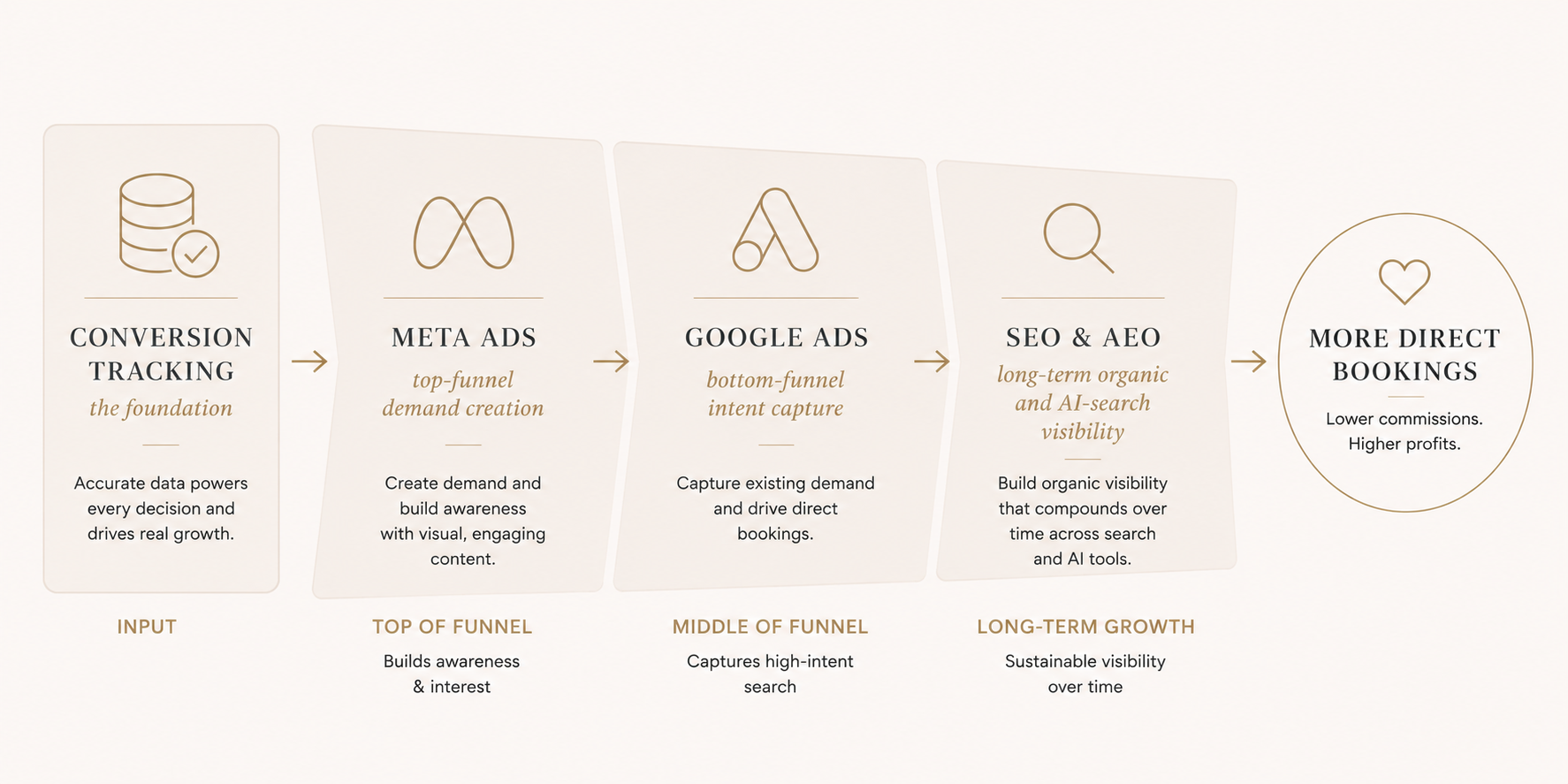
No channel works in isolation. Meta creates the demand that Google later captures. SEO compounds the visibility that paid media rents. Tracking proves which of them actually drove the booking. Run as a system, each channel makes the others more efficient. Run in isolation, each channel underperforms — and you never know why.
Google Ads — bottom-funnel intent capture
Google Ads is usually the first paid channel to turn on because it monetises demand that already exists. 80% of destination marketing organisations use search engine marketing as a core channel (Sojern, 2025). For tour operators and experience providers, Google Ads is the fastest path to direct bookings and the most reliable way to appear above OTA listings for your own experience type.
As of April 2026, Google is consolidating all travel ad formats — hotels, flights, Things to Do — into standard Search campaigns with AI Max capabilities, simplifying campaign management for travel advertisers (Search Engine Journal, April 2026). Performance Max campaigns place ads across Search, YouTube, Maps, Gmail, and Discover from a single campaign, with Google's algorithm optimising for bookings.
Meta Ads — top-funnel demand creation
Meta Ads fills the top of the funnel that Google later captures. In 2026, Meta's Advantage+ campaigns — AI-driven systems that handle targeting, creative optimisation, and budget allocation automatically — consistently outperform manually targeted campaigns for travel advertisers. Travel is inherently visual, and a 15-second video of your experience does more persuasion in three seconds than any ad headline.
Judged only on last-click bookings, Meta looks weak. Judged on its true incremental contribution — the bookings that genuinely would not have happened without the Meta ad — it's often essential. We cover this dynamic in detail in our Google Ads vs Meta Ads guide.
SEO & AEO — long-term organic and AI-search visibility
SEO builds commission-free visibility that compounds over time. Unlike paid media, which stops the moment you stop spending, organic rankings continue to drive traffic and bookings for months or years after the content is published. AEO (Answer Engine Optimisation) extends this to AI-powered search tools — Perplexity, ChatGPT, Google AI Overviews — which are increasingly where travellers start their research.
85% of destination marketing organisations are maintaining or increasing their digital marketing budgets year-over-year, and 63% are already using AI for content creation (Sojern, 2025). The operators who invest in structured, authoritative content now will be the ones AI tools cite and recommend.
Conversion tracking — the foundation
Every budget allocation, every bidding decision, every ROAS calculation depends on accurate booking data. Browser-based tracking misses a share of tour bookings for three documented reasons: Safari caps the cookies it relies on at seven days, ad blockers stop the tags firing, and the checkout completes on the booking platform’s own domain (FareHarbor, Bókun, Rezdy) rather than yours. Without server-side tracking, your campaigns optimise toward incomplete data — and every decision downstream is built on fiction.
This is the most overlooked area in travel marketing, and it's where Tourify is most differentiated. We cover the full problem and fix in our guide to booking attribution and server-side tracking.
Why seasonality changes everything
A standard automated bidding strategy treats every week the same. Travel can't afford that. FareHarbor's own booking data shows that 50% of experience bookings happen within 72 hours of the experience date (Tourpreneur, analysis of FareHarbor trends, 2025) — but the research and comparison stages that precede those bookings start weeks or months earlier. The operator who runs ads and publishes content before a booking window matures captures the demand. The one who launches after the window opens is already late.
Your peak booking window, your shoulder season, and your off-season each need different budgets, different creative, and different goals. Shoulder season is where the smartest operators compete — lower CPCs, less competition, and travellers who are still flexible on dates. Off-season is for content investment and SEO, so you're ranking when the next peak arrives.
Setting a marketing budget
Where you spend matters more than how much.
Percentage-of-revenue rules (“5–12%”) tell a tour operator nothing useful, because revenue is seasonal, capacity caps what extra demand is worth, and a large share of it is already going out as OTA commission. The better method is to set the budget from what you want to achieve and from the commission you are already paying, then allocate in order: capture the demand that already exists (usually Google Ads), layer in Meta for awareness and remarketing once capture is solid, and measure well enough to move money towards what proves out. For paid media, roughly £1,000 a month plus management is the floor at which the platforms have enough data to optimise. The full method, with worked numbers by channel and a 15-minute budgeting exercise, is in our guide to how much to spend on marketing.
Why conversion tracking is the foundation of everything
This is the single most overlooked area in travel marketing. If your booking platform runs its checkout on its own domain — which FareHarbor, Bókun, Rezdy, Peek Pro, Checkfront, Xola, and every other major platform does — your browser-based tracking is almost certainly under-reporting. Meta is hit hardest because its conversions often happen days or weeks after the initial ad view, by which point Safari has deleted the tracking cookie.
Server-side tracking fixes this by sending booking confirmations directly from the server to Google Ads, Meta's Conversions API, and GA4 — bypassing browser restrictions entirely. Every confirmed, paid booking is accurately attributed to the campaign, keyword, and audience that produced it. We cover the full problem and fix — including a two-minute reconciliation test you can run right now — in our guide to booking attribution and server-side tracking.
Frequently asked questions
What is the most important marketing channel for a travel business?
There is no single most important channel — the answer depends on where your bookings currently come from and where demand exists. For most travel businesses with proven search demand, Google Ads is the fastest path to direct bookings. For visually-driven experiences with limited search volume, Meta Ads creates the demand that other channels later capture. SEO is the most important long-term channel because it compounds visibility without ongoing ad spend. But none of them perform well without accurate conversion tracking — which is why tracking is the true foundation.
How long does travel marketing take to show results?
Google Ads can produce bookings within the first week if demand exists and tracking is set up correctly. SEO typically takes 3–6 months to show meaningful organic traffic gains, though competitive keywords can take longer. Meta Ads usually need 2–4 weeks to clear the learning phase and start producing stable results. The real answer depends on your starting point — an operator with existing search demand and a functional website will see results faster than one building from zero.
Can marketing reduce my dependence on OTAs?
Yes — that's the primary commercial purpose. OTAs now capture 37% of all tour and activity bookings, up from 28% just two years ago, while direct website bookings have declined (Arival, 2025). Every booking you win through direct channels — via Google Ads, Meta, SEO, or your own email list — saves you the 20–30% commission the OTA would take. A well-run Google Ads campaign typically achieves a cost per booking of £15–60, which is a fraction of what OTAs charge on the same sale.
Do I need all the channels at once?
No. Most travel businesses should start with one or two channels and expand as tracking proves what works. The typical sequence is: (1) fix tracking so you can measure accurately, (2) launch Google Ads to capture existing search demand, (3) add Meta retargeting to recapture website visitors who didn't book, (4) add Meta prospecting and SEO as you scale. Starting everything simultaneously spreads budget too thin and makes it impossible to attribute results to specific channels.
How is Tourify different from other travel marketing agencies?
Tourify works exclusively with travel and tourism businesses — tour operators, experience providers, DMCs, and activity companies. We don't serve other industries. Every campaign, tracking implementation, and strategy engagement is built around the specific dynamics of travel: seasonal demand cycles, booking platform attribution gaps, OTA competition, and the multi-touchpoint journey travellers take from inspiration to booking. We also implement server-side tracking as standard across all client accounts, which means every booking is accurately attributed — not estimated or modelled.
What does a travel marketing strategy engagement include?
A strategy engagement maps your current position — where bookings are coming from, what's leaking to OTAs, where tracking gaps exist — and recommends the highest-impact moves across paid media, SEO, and tracking. It's specific to your business, your markets, and your margins. It's not a generic template. The output is a prioritised plan you can act on immediately, whether you implement it with Tourify or independently.
Get a Free Travel Marketing Review
We work exclusively with travel and tourism brands. Send us your current setup and we'll map the highest-impact next moves across paid media, SEO, and tracking — no pitch, no obligation.
Claim your free review →